One world. Dozens of players. Always in motion.
World Table campaigns are massive-multiplayer, persistent West Marches worlds. Dozens of players share one living world, form their own adventuring parties, and get dispatched on quests — run by a team of co-GMs with full, equal control. You choose World Table when you create a campaign, and your world never stops between sessions.
No credit card. 5e today, more systems coming.
What it is
The West Marches, without the wall of forum threads.
The old world-table dream: a shared world, a rotating cast of players, and adventuring parties that form on the fly around whoever is online this week. No single fixed group. No campaign that stalls because two people are on holiday. The world is always open.
It used to take a heroic GM and a sprawl of forum threads, spreadsheets, and pinned messages to keep it all straight. Convoke builds the whole format in — parties, party channels, a living overworld map, quest voting, and co-GMs — so a massive-multiplayer world runs itself instead of running you.
How an World Table world works
Everything a living world needs, built in.
One persistent world, many parties
An World Table campaign holds dozens of players — 30, 60, 100 or more — in a single, continuous world. The story never pauses for a scheduling thread; it advances wherever a party is active.
- Massive-multiplayer: many parties share one world
- A persistent world that keeps living between sessions
- Set your world's player cap and party sizes at creation
Players form their own parties
Anyone in the world can start a party or join one. A character belongs to one party at a time — so leaving one band and joining another is a real, in-world decision. Parties create, join, leave, and disband as the story moves.
- Player-formed parties — create, join, leave, disband
- One party per character at a time
- The roster is the players', not a GM chore
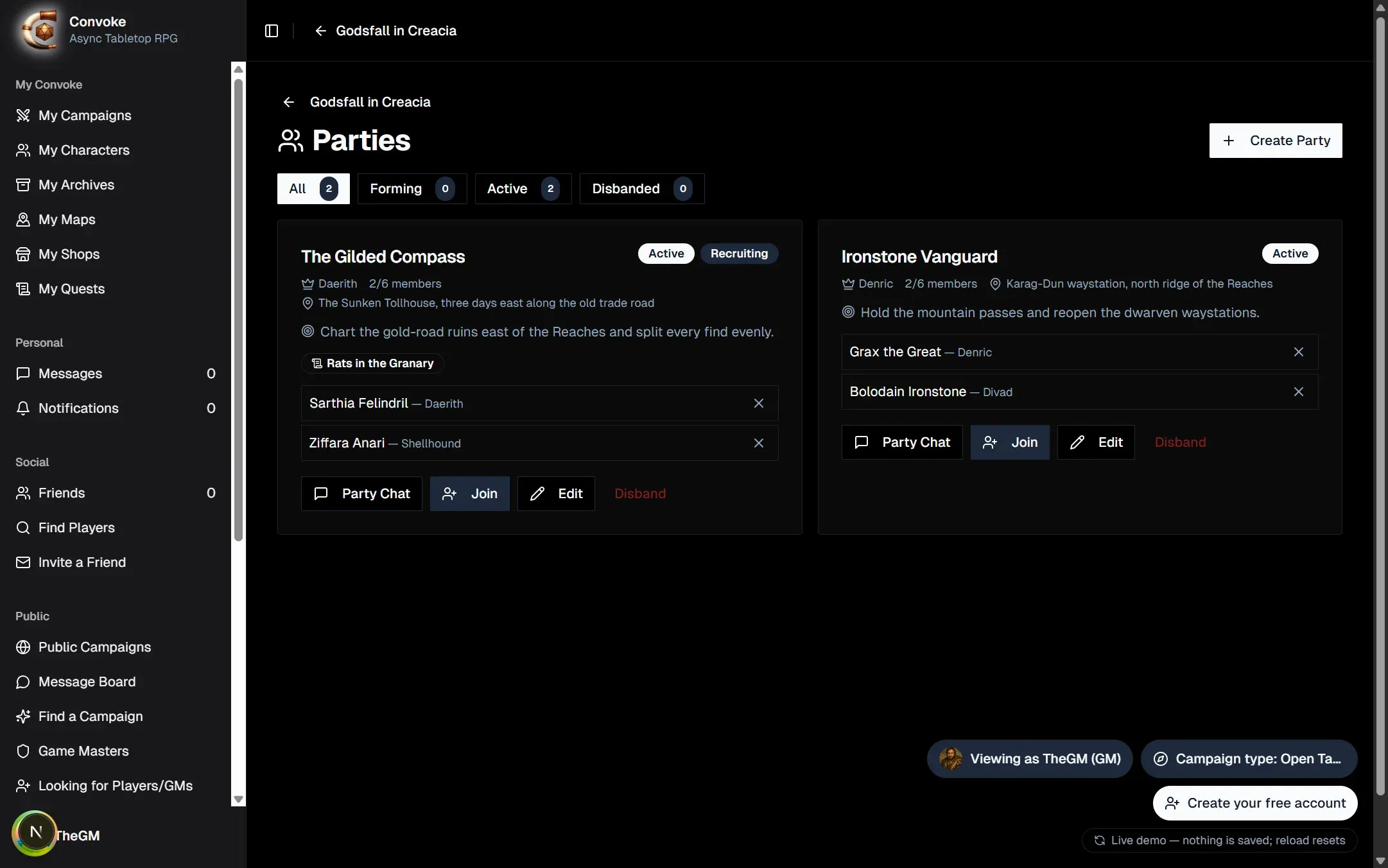
Every party gets its own channel
Each party plans and roleplays in its own chat lane — a dedicated party channel that keeps their thread of the story together. Your GMs can always read every channel, so nothing important ever drifts out of view.
- A dedicated chat lane per party
- GMs always have full visibility into every channel
- Keeps parallel parties from stepping on each other
Run it with co-GMs, as equals
A world this size is too much for one person — so it does not have to be one person. Add co-GMs with full, equal control. Every GM can author content and manage members. No single bottleneck, no "only the owner can do that."
- Multiple co-GMs with full, equal control
- Every GM can author content and manage members
- Share the load of a living world
A living overworld map
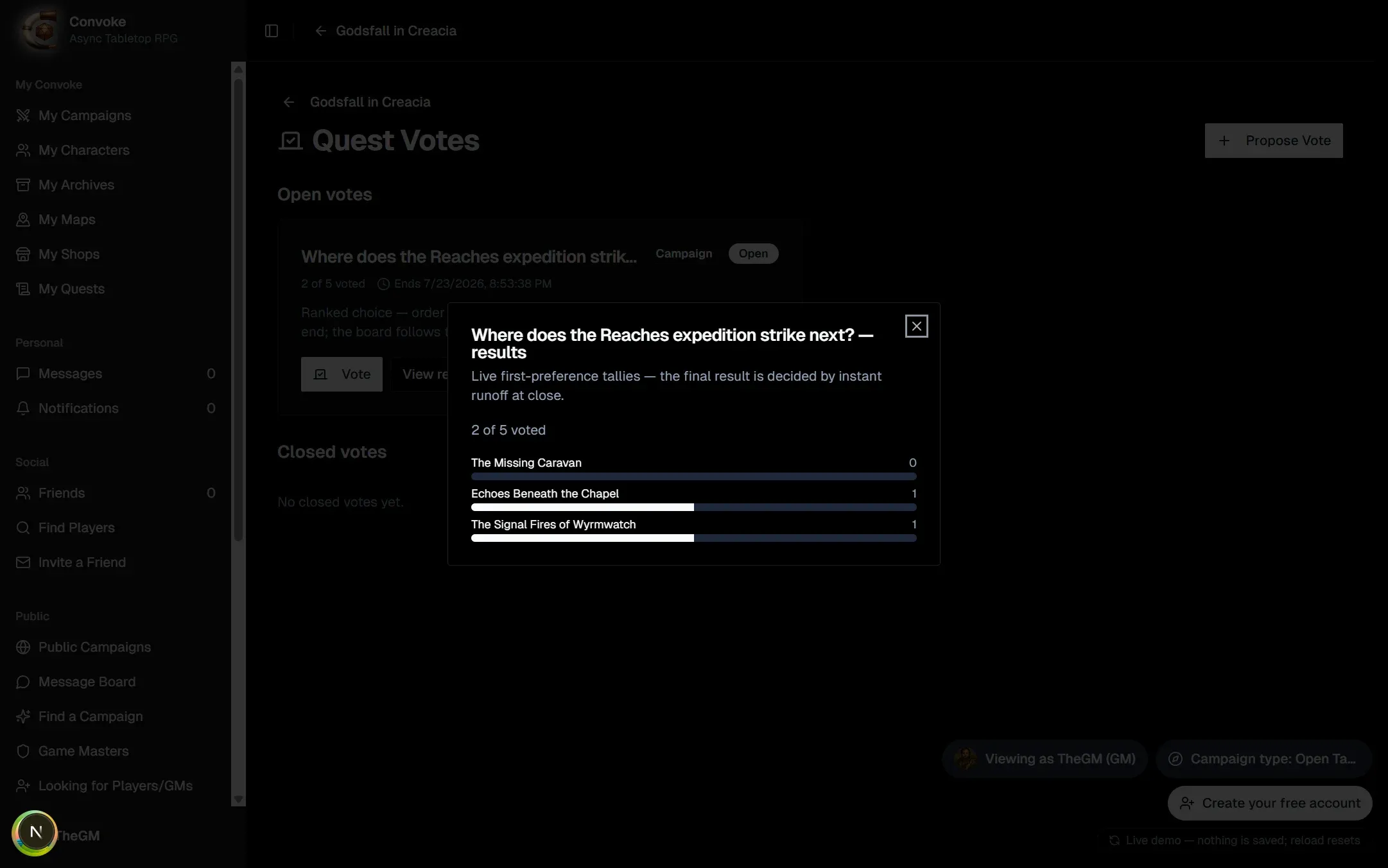
The world reveals itself as players explore. Locations surface on a shared overworld map in stages — hidden, then rumored, then discovered — and each pin ties to a real quest or shop your players can actually act on.
- Knowledge-staged pins: hidden, rumored, discovered
- Pins reference real quests and shops, not flavor text
- The map grows as parties push into the unknown
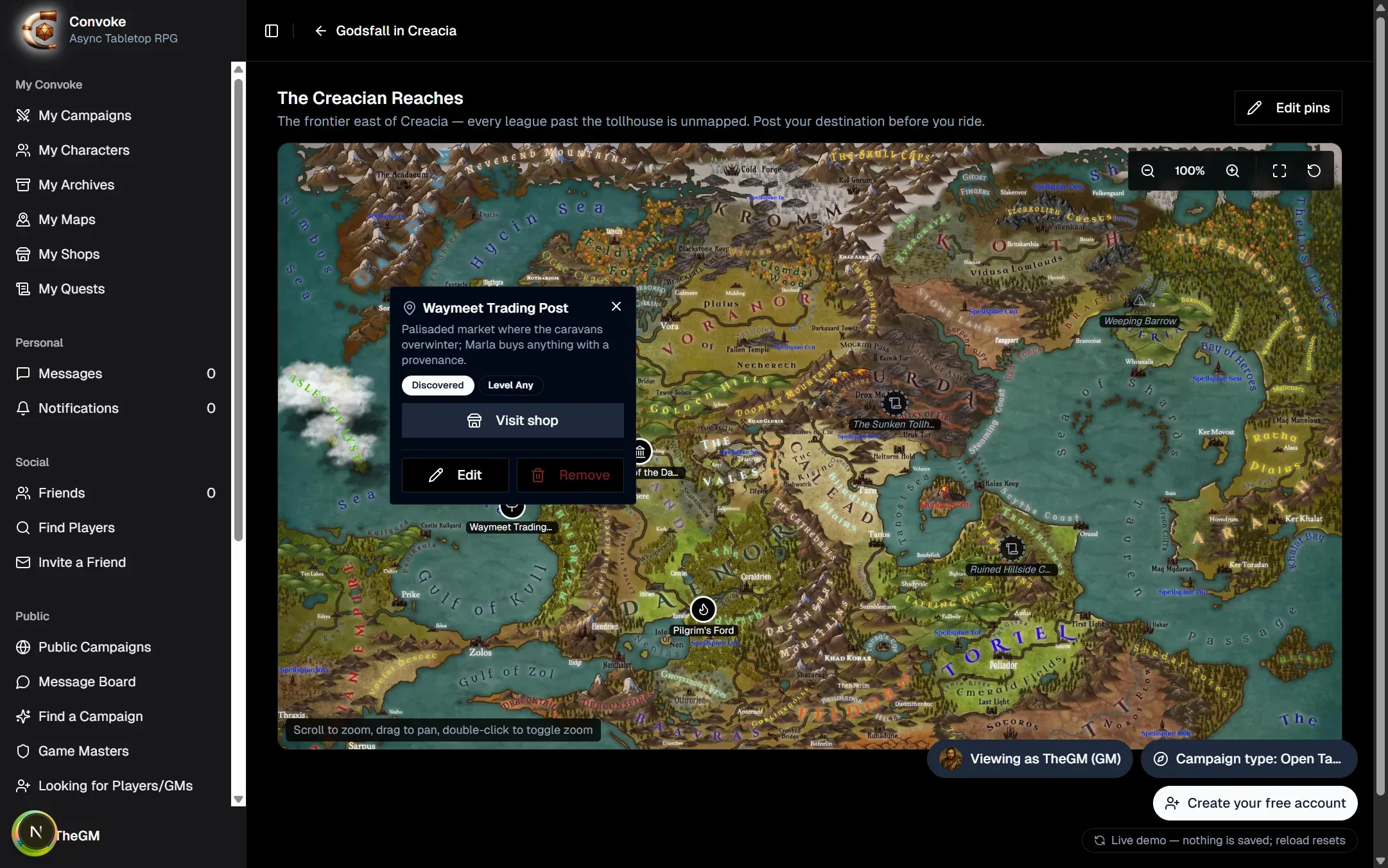
Vote on your next quest
When a party cannot agree on what is next, they rank the options instead of arguing. Convoke runs a ranked-choice vote and dispatches the winning quest straight to the party — form a party, hold a vote, get dispatched.
- Ranked-choice (instant-runoff) quest voting
- The winning quest is dispatched to the voting party automatically
- No table debate, no GM tie-breaking
A standard campaign vs. an World Table world.
Both are first-class in Convoke. You choose which kind of campaign to run when you create it.
Players
Standard campaign
One fixed party
World Table world
Dozens, across many parties
Group structure
Standard campaign
The GM's roster
World Table world
Player-formed parties (join, leave, disband)
Running it
Standard campaign
Usually one GM
World Table world
A team of co-GMs with full parity
The map
Standard campaign
A reference image
World Table world
Knowledge-staged pins tied to real quests and shops
Choosing what is next
Standard campaign
The GM decides or the table debates
World Table world
A ranked-choice party vote that dispatches the quest
Between sessions
Standard campaign
The world waits for the group
World Table world
A persistent world that keeps moving
How to run one.
1. Create an World Table campaign
You choose World Table when you create the campaign, and set your world's player cap and party sizes. This is a world built for many hands from day one.
2. Players form parties
Players start their own parties or join existing ones — one party per character at a time. Each party gets its own channel to plan and play in, and your GMs can read them all.
3. Explore a living overworld
As parties push outward, the overworld map reveals pins in stages — hidden, rumored, then discovered — each tied to a real quest or shop waiting to be taken on.
4. Vote and get dispatched
When a party is split on where to go next, they hold a ranked-choice vote. The winning quest is dispatched straight to that party — no debate, no bottleneck.
5. Share the world with co-GMs
Bring on co-GMs with full, equal control. Everyone can author quests and shops, manage members, and keep the world moving — so no single person has to be online for the story to advance.
Who it is for.
- GMs who have always wanted to run a West Marches game but never had the tooling
- Big communities and servers who want one shared world instead of a dozen disconnected tables
- Co-GM teams who want to run a world together as equals
- Players who want a living world they can drop into for a session and shape over time
Build a world that never has to pause.
World Table campaigns are free in open beta, like everything else. Start one, or explore the demo world first.